
The Spectator Effect: Why You Break Your Trading Rules (And Why It Isn’t a Lack of Discipline)
Why do traders break their trading rules? Discover the Spectator Effect, amygdala hijack under financial stress, and actionable neuroscience techniques to regulate your nervous system mid-trade.
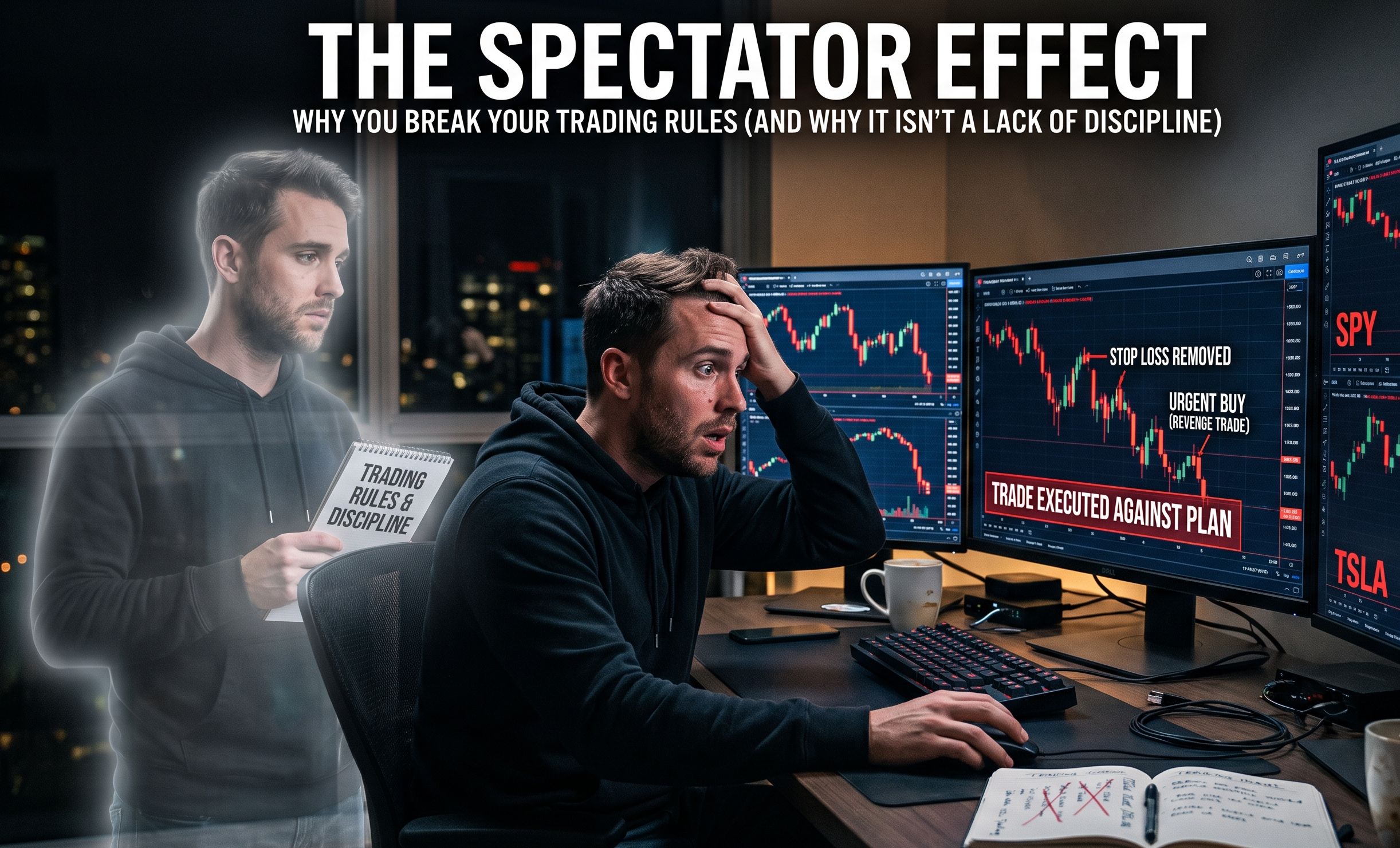
⚡ Quick Answer: Why Do You Break Your Trading Rules?
- The Spectator Effect: When financial stress triggers an amygdala hijack, your survival brain takes over motor functions while your prefrontal cortex is temporarily benched—leaving you feeling like a helpless spectator watching yourself make bad trades.
- Not a Discipline Problem: Moving stop losses and revenge trading are physiological fight-or-flight responses to perceived survival threats, not a moral failure or lack of discipline.
- The Solution: Willpower cannot override an active nervous system alarm. Traders must use physiological circuit breakers (somatic tracking, physiological sighs) and automated software lockouts to protect capital during high arousal.
You know the rules. You wrote them down. You backtested your strategy, you know your risk limits, and you swore to yourself that this time would be different.
Then, the market moves against you. Suddenly, there is an intense, rushing urgency. You move your stop loss. You double down on a losing position. You revenge trade. And the most agonizing part? A quiet, rational part of your brain is wide awake the entire time, watching you make the mistake, screaming at you to stop—but you can’t. Your awareness has been reduced to a spectator in your own mind.
If you have experienced this, you have probably beaten yourself up for lacking discipline. But the gap between knowing what to do and actually doing it isn't an issue of willpower.
It is a nervous system regulation problem.
The Hijacked Brain
To understand why you become a "spectator" to your own bad trades, you have to look at what happens in your brain under stress.
Your trading rules, your discipline, and your logical awareness live in the prefrontal cortex—the thinking brain. But when your nervous system perceives a sudden threat (like a spike in volatility, a blown trade, or the fear of missing out), your amygdala—the survival brain—takes over.
The survival brain moves infinitely faster than the thinking brain. It bypasses logic and hijacks your motor functions to take immediate, defensive action. Your prefrontal cortex stays "online" just enough to watch the wreckage, but it has been temporarily locked out of the control room. That’s why you feel like a passenger in your own body.
The Market is Not a Predator
Your nervous system evolved to keep you alive, and unfortunately, it doesn't know the difference between "I'm about to lose $500" and "I'm about to be chased by a predator." Both trigger the sympathetic nervous system—the classic fight-or-flight response.
That sudden "hurry" or urgency you feel mid-trade? That is adrenaline and cortisol flooding your system, demanding immediate action to escape danger. In the wild, fighting back saves your life. On the charts, "fighting back" looks like revenge trading, and "escaping danger" looks like closing a winning trade way too early just to lock in the safety of a profit.
Why "Trying Harder" Always Fails
If you diagnose this as a discipline problem, your solution will always be to "try harder," "be stricter," or put a sticky note on your monitor that says Stick to the Plan.
But you cannot logic your way out of a physiological response. You cannot out-think a nervous system that is in a state of alarm. Willpower requires the prefrontal cortex, and in that moment, your prefrontal cortex has been benched.
You don't need a better trading strategy. You need a physiological circuit breaker.
How to Regulate Your Nervous System Mid-Trade
Once you stop fighting your lack of willpower and start managing your neurobiology, everything changes. Here is how you bridge the gap between knowing and doing:
- Track Your Somatic Tells: Before the "spectator" phase begins, your body gives you warning signs. Does your breathing get shallow? Do your shoulders creep up to your ears? Does your vision narrow until you only see the blinking red numbers? You have to learn your physical cues and catch the arousal before the limbic system completely takes over.
- Install Hard Circuit Breakers: Because your thinking brain gets locked out, you cannot rely on willpower to stop trading in a triggered state. You need physical barriers. Close the laptop. Walk out of the room. At Treydly, we advocate for using hard limits—software lockouts that physically prevent you from placing another trade after a certain drawdown.
- Convince Your Body It Is Safe: When the urgency hits, your mind cannot make a good decision until your body feels secure. Use physical interventions: do a "physiological sigh" (two sharp inhales followed by a long, slow exhale to lower your heart rate), run cold water over your wrists, or physically step outside.
Forgive yourself for the times you watched yourself break your own rules. Your biology was doing exactly what it was designed to do to keep you safe from a perceived threat.
The next evolution in your trading journey isn't learning a new chart pattern. It is simply teaching your nervous system that the blinking numbers on a screen are not a tiger. Tracking your emotions and rule compliance in a structured trading journal is the first step toward mastering your physiological responses.
Start tracking your trading psychology with Treydly →
Frequently Asked Questions (FAQ)
What is the Spectator Effect in trading psychology?
The Spectator Effect in trading describes a state where a trader watches themselves make destructive trading mistakes—like moving stop losses, doubling down, or revenge trading—while a rational part of their brain is fully aware of the error but feels powerless to stop it. This occurs because financial stress triggers an amygdala hijack, temporarily locking the prefrontal cortex out of motor control.
Why do traders break their trading rules despite having a tested strategy?
Traders break rules due to a nervous system regulation problem rather than a lack of discipline. Under severe market volatility or financial threat, the body triggers a fight-or-flight response. The surge of cortisol and adrenaline bypasses logical prefrontal cortex processing and forces defensive survival behaviors like closing winning trades prematurely or fighting the market to recover losses.
How can I stop revenge trading and amygdala hijacks mid-trade?
To stop revenge trading, you must implement physiological circuit breakers: 1) Identify somatic cues (shallow breathing, muscle tension) before high arousal peaks; 2) Step away from the screen or use software hard limits (such as automated drawdown lockouts in Treydly); and 3) Perform physical resets like the physiological sigh (two sharp inhales followed by a long exhale) to lower heart rate and restore prefrontal cortex function.
Why does willpower fail during trading losing streaks?
Willpower requires active functioning of the prefrontal cortex—the logical, analytical center of the brain. When experiencing a losing streak, the limbic system perceives an imminent survival threat and diverts cognitive resources to the amygdala. Because you cannot out-think an active physiological alarm state, relying on willpower alone consistently fails without environmental and somatic intervention.
Track this in Treydly — free
Connect your MT5, MT4, or cTrader account, import your trade history, get all your statistics instantly.
Create Free Account