The Hybrid Trader: Why Your Automated Scanners Need a Discretionary Journal in 2026
Discover what a Hybrid Trader is and why blending algorithmic trading scanners with discretionary execution and trade journaling is the ultimate retail edge in 2026.
What is a Hybrid Trader?
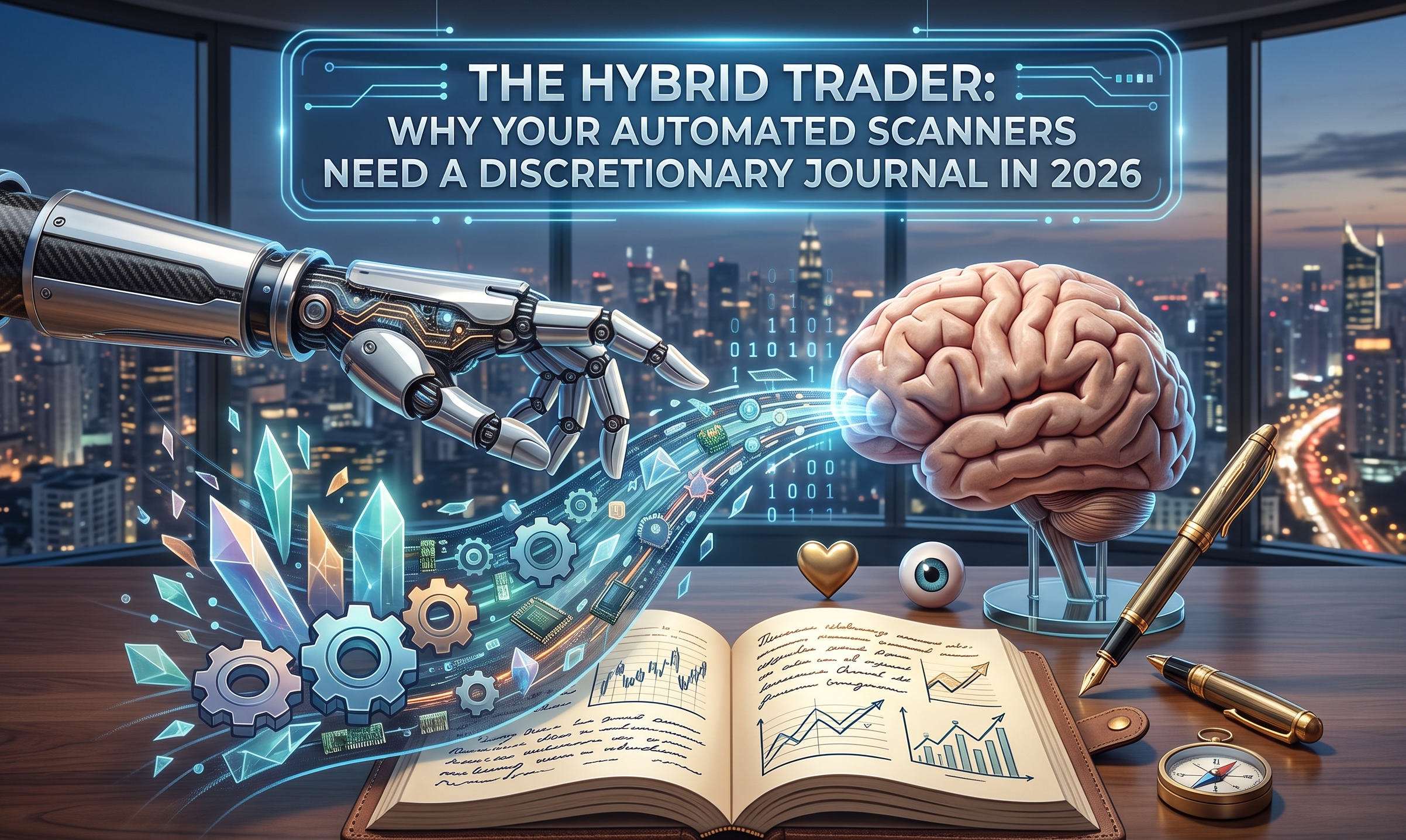
A Hybrid Trader is a market participant who blends algorithmic automation with human discretion. They use code—like Python scripts or Pine Script—to scan the market and identify high-probability setups, but rely on human intuition and manual execution to manage entries, risk, and macroeconomic context.
The retail trading landscape has shifted. If you look around this year, almost every serious trader is leveraging some form of code. We are building custom Pine Script indicators, wiring up Python backtesters, and streaming WebSocket data to get an edge.
But there is a dangerous trap here. The moment a retail trader writes their first script, they often fall for the "set and forget" myth—the idea that you can code a bot, turn it on, and walk away.
In reality, pure algorithmic trading is a brutal game dominated by institutional quants with latency advantages and massive infrastructure. For the serious retail trader, the actual edge doesn't lie in replacing yourself with a machine. It lies in becoming a Hybrid Trader: using automation to do the heavy lifting of scanning, but retaining human discretion for execution and risk management.
And the only way to prove that your hybrid system actually works in live markets is through rigorous, data-driven trade journaling.
The Trap of the "Perfect" Backtest
If you have ever built a strategy in TradingView or Python, you know how easy it is to curve-fit historical data. A backtest might show a beautiful, upward-sloping equity curve, but historical data is static. It doesn’t account for sudden market regime shifts, widening spreads during news events, or the psychological pressure of executing during a drawdown.
Even if you apply advanced concepts to your models—like using fractional differentiation to make your price data stationary without losing memory, or applying triple barrier labels to categorize your trade outcomes—a backtest is still just a hypothesis.
A backtest tells you what should have happened. Forward-testing in a live market tells you what is happening.
The Discretionary Edge: Why Your Brain Beats AI
There is a reason the best retail traders haven't been entirely replaced by bots. The human brain is the ultimate nonlinear processing engine.
While an AI or a coded algorithm is strictly bound by the historical parameters of its training data, human intuition is fluid. A bot looks at market data linearly: if X conditions are met, execute Y. But live markets are chaotic, messy, and highly nonlinear.
When a macroeconomic shock hits, or when intermarket correlations temporarily decouple, an automated script will often just keep firing blindly into the chop, destroying your equity curve. A human trader, however, can instantly synthesize context that code cannot. You can read the subtle, unquantifiable shifts in price action, recognize that the "character" of the tape has changed, and simply choose to sit on your hands. Code is rigid; the discretionary human mind is adaptable.
Automate the Scan, Humanize the Execution
The Hybrid Trader uses code to filter out the noise so they only look at the charts when there is a high-probability setup.
Think about how this applies to modern retail workflows:
- Trading the Extremes: Instead of staring at the charts and accidentally trading the chop inside the Asian session, you build a Pine Script that alerts you only when liquidity is swept at the exact high or low of the Asian range—with a strict condition that your EMA200 must be inside that range for the signal to be valid.
- Order Book Tracking: You run a Python backend streaming a live order book heatmap for BTCUSDT via WebSockets, triggering an alert when passive limit orders stack up heavily on the bid.
The code alerts you. But you look at the context. You check the broader market structure on XAUUSD or EURUSD, verify the economic calendar, factor in the nonlinear variables, and decide if the sweep is a trap or a valid entry.
Bridging the Gap: Why You Must Journal Your Scanners
This is where most technically inclined traders drop the ball. They build a great scanner, take the trades, and when they hit a losing streak, they don't know if the market changed or if their code is flawed.
To survive, you have to treat your custom indicators and scanners as employees, and your trading journal is their performance review.
1. Tagging the Algorithm
When you log a trade, it’s not enough to just record the asset and the PnL. You need a rigorous tagging system. If you took a trade based on your Asian range sweep script, tag it #AsianSweep_V2. If it was generated by your Python order book model, tag it #Heatmap_Long. Over a sample size of 50 trades, your journal will definitively tell you which script is printing money and which one is slowly bleeding your account.
2. Calibrating True Risk
A backtest might suggest using an aggressive Kelly Criterion model for position sizing. But live markets are messier. A professional journal allows you to calibrate your dollar risk against your actual live base rate and strict risk-per-trade parameters, keeping you grounded in reality rather than theoretical math.
3. Catching Logic Flaws
Forward-testing through a journal catches the logic flaws that backtests miss. You might realize your script fires great signals, but your live slippage makes the strategy unprofitable. Or you might find that you consistently override the script's exit signals manually—and your journal will tell you whether your manual intervention is actually making you more money or costing you ticks.
The Bottom Line
You don't need to be an institutional quant to use data like a professional. You just need to build smart tools to do the heavy lifting, and use a rigorous journal to verify them.
Stop guessing if your custom indicators are actually working. Track the data, find your true base rate, and scale the setups that prove themselves in the live market.
Ultimately, the algorithm is just a tool to get your attention. At the end of the day, the strategy isn't the Python script, the Pine Script indicator, or the automated scanner. The strategy is you.
Frequently Asked Questions
What is a Hybrid Trader?
A Hybrid Trader is a market participant who blends algorithmic automation with human discretion. They use code—like Python scripts or Pine Script—to scan the market and identify high-probability setups, but rely on human intuition and manual execution to manage entries, risk, and macroeconomic context.
Why is forward-testing better than a backtest?
While backtests evaluate historical, static data, forward-testing assesses a strategy in live, dynamic markets. Forward-testing accounts for slippage, changing market regimes, and execution psychology, which backtests often miss.
How do you journal an algorithmic trading strategy?
You should treat your automated scanners like employees. Tag each trade with the specific scanner or algorithm that generated the signal (e.g., #AsianSweep_V2). Review these tags in your trading journal to see which algorithms are profitable in live market conditions.
Track this in Treydly — free
Connect your MT5, MT4, or cTrader account, import your trade history, get all your statistics instantly.
Create Free Account