
The Silent Profit Killer: Is Overtrading Ruining Your Strategy?
Discover how overtrading silently destroys disciplined strategies. Learn to identify the danger zone, understand the psychology behind it, and set hard daily limits to protect your edge.
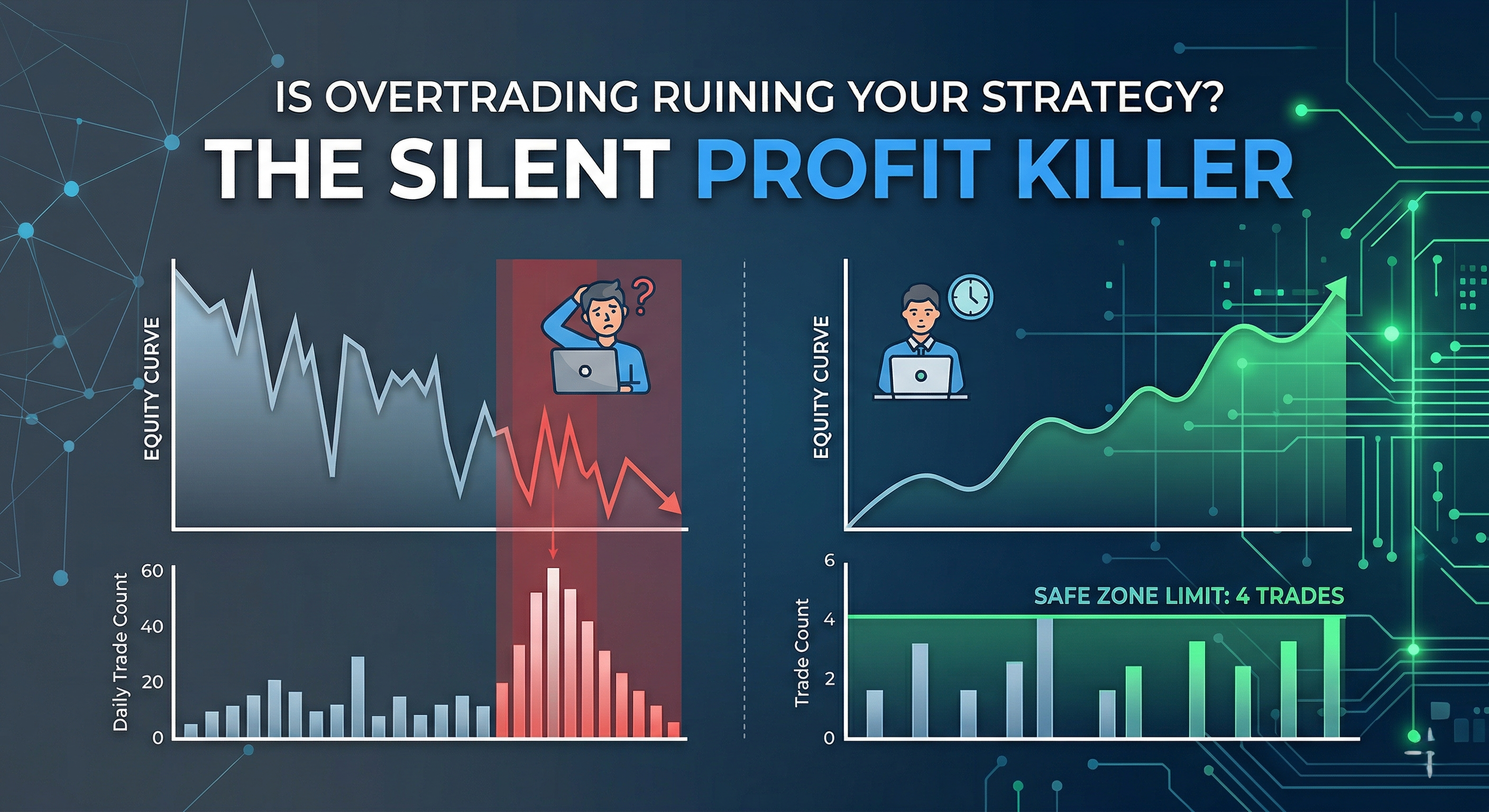
You've backtested your strategy, you understand your edge, and you've waited for the perfect setup. Yet, at the end of the month, your account balance is stagnant — or worse, declining. If your technical analysis is sound but your results aren't following suit, you likely have a hidden leak: Overtrading.
Overtrading is the single most common reason why disciplined strategies fail. It's the point where "trading the market" turns into "chasing the market."
The Math of a Trading "Crash"
If you analyse the history of a failing account, the downward spikes in equity rarely come from one bad trade. Instead, they almost always correlate with high-volume days.
- Activity vs. Profitability: There is often an inverse relationship between the number of trades you take and your actual success rate.
- The Volume Spike: When you look at your daily trade count, the days with the highest number of entries are usually the days where your account takes the biggest hits.
- The Breaking Point: Every trader has a threshold — a specific number of trades per day — beyond which their decision-making quality drops off a cliff.
Why We Lose Control
Overtrading is rarely a logical choice; it's an emotional one. It usually manifests in two dangerous cycles:
- Revenge Trading: You take a loss and immediately try to "win it back" by forcing a second, lower-quality trade.
- The Winning Streak Trap: A string of wins makes you feel invincible, leading you to take "bonus" trades that aren't actually part of your plan.
In both scenarios, you stop trading your system and start trading your emotions.
How to Build a "Danger Zone" Shield
To stay profitable, you must stop guessing why you are losing and start setting hard boundaries. Professional trading requires removing the "maybe" from your daily routine.
- Set a Hard Daily Limit: Define exactly how many trades you are allowed to take per day. For many professionals, anything over four trades puts them in a high-risk "Danger Zone."
- Visual Accountability: You need a way to track your trade count against your performance. When you can see a direct visual link between high trade volume and account losses, the urge to overtrade disappears.
- Respect the Rules: Once you hit your limit, the trading day is over. No exceptions.
Turn Your Curve Around
Success in trading isn't about being active every hour the market is open; it's about being disciplined when it matters most. By setting strict rules for your trade frequency, you protect your capital and allow your edge to actually work.
Ready to stop the guesswork? Start tracking your trade frequency and set your personal rules today at Treydly → to see exactly where your profits are going.
Track this in Treydly — free
Connect your MT5, MT4, or cTrader account, import your trade history, get all your statistics instantly.
Create Free Account