
Trading Winning Streak Psychology: Why Hot Streaks Create Hidden Risk
Winning streaks rewire your brain for streak preservation, not profit. Learn 3 professional reset techniques to defuse performance anxiety before it triggers tilt.
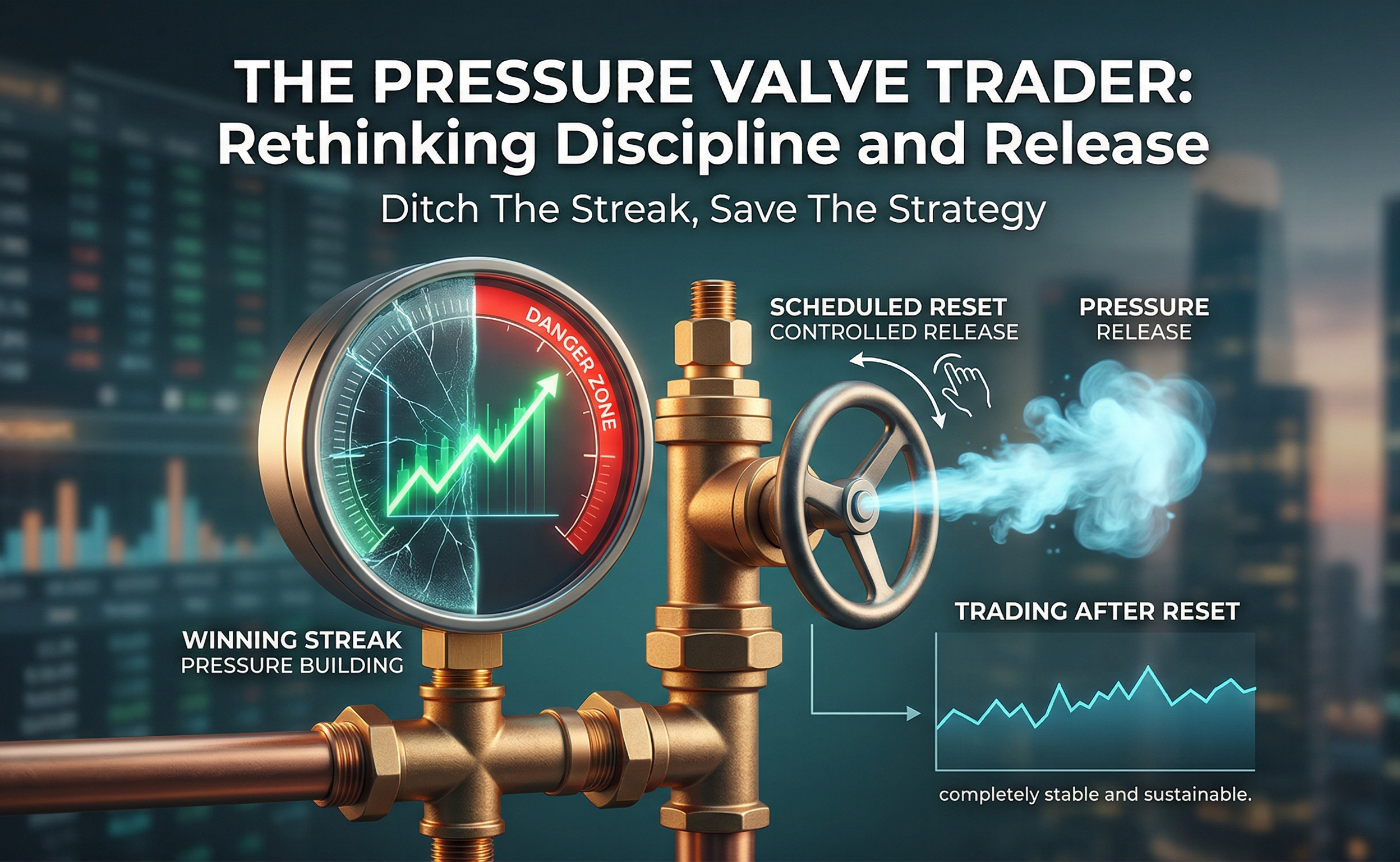
Three green days in a row. Four. Five. The account is growing, the setups are clicking, and everything feels right. Most traders assume this is when they are at their peak.
The data disagrees. For many retail traders, a long winning streak is one of the highest-risk periods in their trading calendar — not because the market changes, but because they do.
Why Your Brain Becomes Your Enemy on a Hot Streak
Every consecutive win triggers a dopamine release. Over multiple days, this creates a compounding neurological effect: your confidence grows, your perception of risk drops, and your brain gradually shifts its objective.
You stop trading to find good setups. You start trading to protect the streak.
This is the core of winning streak psychology — the mental shift from "what is the market doing?" to "how do I not ruin this?" Position sizes creep up. You enter marginal setups because sitting out feels dangerous. You move stop losses to avoid the loss that would end the run.
None of this is conscious. The prefrontal cortex — the part responsible for rational risk assessment — is partially bypassed by the limbic system when emotional stakes are high. A five-day winning streak raises the emotional stakes considerably.
The result is a trader experiencing massive performance anxiety while simultaneously believing they are at their most confident. The two feelings coexist, and the anxiety wins.
The Tilt Trigger: Why the Loss Hits So Hard
When the inevitable loss arrives — and it always does — the psychological response is disproportionate to the financial one.
The loss itself might be small, well within your normal risk parameters. But the meaning attached to it is enormous: the streak is over. All that accumulated pressure, all the anxiety of preservation, releases at once. The brain interprets it as a catastrophic failure, not a normal trading outcome.
This is the mechanism behind tilt and revenge trading. The trader does not re-enter because they have a good reason to — they re-enter because the emotional release of the loss has disrupted rational processing. The next trade is typically larger, rushed, and based on a worse setup. In many cases, a single tilt session wipes out the gains from the entire winning streak.
The streak did not cause the loss. The streak caused the reaction to the loss.
The Scheduled Reset: A Pressure Release Valve That Actually Works
The scheduled reset is a deliberate, planned intervention that breaks the psychological momentum of a winning streak on your terms — before the market breaks it on its terms.
The mechanism is neurological. When you control the end of the streak, your brain receives a different signal. Instead of the streak collapsing under a real loss that triggers the full tilt response, you interrupt the cycle. You are telling your nervous system: "The streak is over. The pressure is gone. We are back to baseline."
The key word is scheduled. This is not impulsive. It is a pre-committed rule you create during a calm, rational moment — not in the middle of a hot streak when your judgment is already compromised. You define the trigger in advance: after three consecutive green days, after a certain profit threshold, after a set number of winning trades.
When the trigger condition is met, the reset protocol executes automatically.
Three Professional Reset Techniques
There is no single correct way to execute a scheduled reset. The right method depends on your trading style and what drives your streak anxiety most. Here are three approaches used by professional traders:
1. The Micro-Size Trade
You still wait for your highest-quality setup — your "A+" entry with full confirmation. You do not skip your process or take a deliberately bad trade. But when you pull the trigger, you execute at 10% of your normal position size.
If you win, great — you've added to the streak but with almost no risk. If you lose, the financial impact is negligible, but the streak is broken voluntarily and on a good trade. The pressure releases without meaningful damage to your account.
Critically, this avoids a common mistake: some traders deliberately take a bad trade just to end a streak. That trains your brain to ignore your edge and accept substandard setups. The micro-size approach preserves your process integrity while still achieving the psychological reset.
2. The Forced Timeout
After a pre-defined number of consecutive green days — typically three — you mandate a 24-hour period where you do not open your charts.
Log the trigger in your trading journal. Write down today's equity, your current win streak count, and your plan for tomorrow. Then close your platform and do not return until the timeout expires.
This breaks two things simultaneously: the physiological stress response that builds from continuous screen time during a streak, and the information loop that keeps feeding your brain new stimuli to react to. Cortisol drops. The dopamine cycle resets. When you return to the charts, you are genuinely calmer — not just telling yourself you are.
3. The Profit Sweep
After a strong winning run, you withdraw a meaningful portion of your recent gains into your bank account — typically 25–50% of the profit made during the streak.
This works on a concrete psychological level: your account balance drops back toward your psychological baseline. The "streak money" is physically separated from your trading capital and locked away. Your brain's threat-detection system interprets this correctly — the gains are secure and cannot be lost.
The result is that your next session starts from a different reference point. The emotional weight of "protecting the streak's winnings" is partially removed. You are, in a genuine sense, playing with less at stake.
As a secondary benefit, regular profit withdrawals enforce the discipline that trading profits are real money — not just numbers on a screen to be risked in the next session.
Building the Reset Into Your Trading Rules
A scheduled reset only works if it is documented before you need it. When you are already three days into a winning streak, you are the worst possible judge of whether a reset is necessary. Your confidence is high, your risk perception is low, and every instinct will tell you to keep going.
The solution is pre-commitment: write your reset rule into your trading plan today, in a calm state, with no active streak. Treat it the same way you treat your stop loss rules — non-negotiable, applied automatically when the trigger condition is met.
In your trading journal, log every winning streak and every reset. Track how you trade in the session immediately after a reset versus the session where you ignored one. The data will make the case far more convincingly than any advice can.
Your psychology is not separate from your edge — it is part of it. Managing performance anxiety during winning streaks is as much a skill as reading price action, and it compounds the same way.
Track your winning streaks and trading psychology with Treydly →
Track this in Treydly — free
Connect your MT5, MT4, or cTrader account, import your trade history, get all your statistics instantly.
Create Free Account