
Static vs Trailing Drawdown in Prop Firm Challenges
Understand the critical difference between static and trailing drawdown in prop firm challenges — and why misunderstanding this rule is one of the most common reasons traders fail.
The One Rule That Matters Most
Many traders believe they fail prop firm challenges because their strategy isn't good enough. They spend months changing indicators, testing new entries, or copying different strategies.
But one of the most common reasons traders fail is much simpler: they don't fully understand the drawdown rules.
When you start a prop firm challenge, there are many rules: profit targets, daily drawdown limits, maximum loss limits, and trading restrictions. But there is one rule that matters more than anything else: your maximum drawdown.
If you hit it, the account is gone. No second chances.
And depending on the firm and the type of challenge, that drawdown is usually structured in one of two ways: Static Drawdown or Trailing Drawdown.
Static Drawdown
Let's start with the simpler model: static drawdown.
Imagine you begin a challenge with an account size of $100,000 and a maximum drawdown of 5%. That means your absolute loss limit is $95,000.
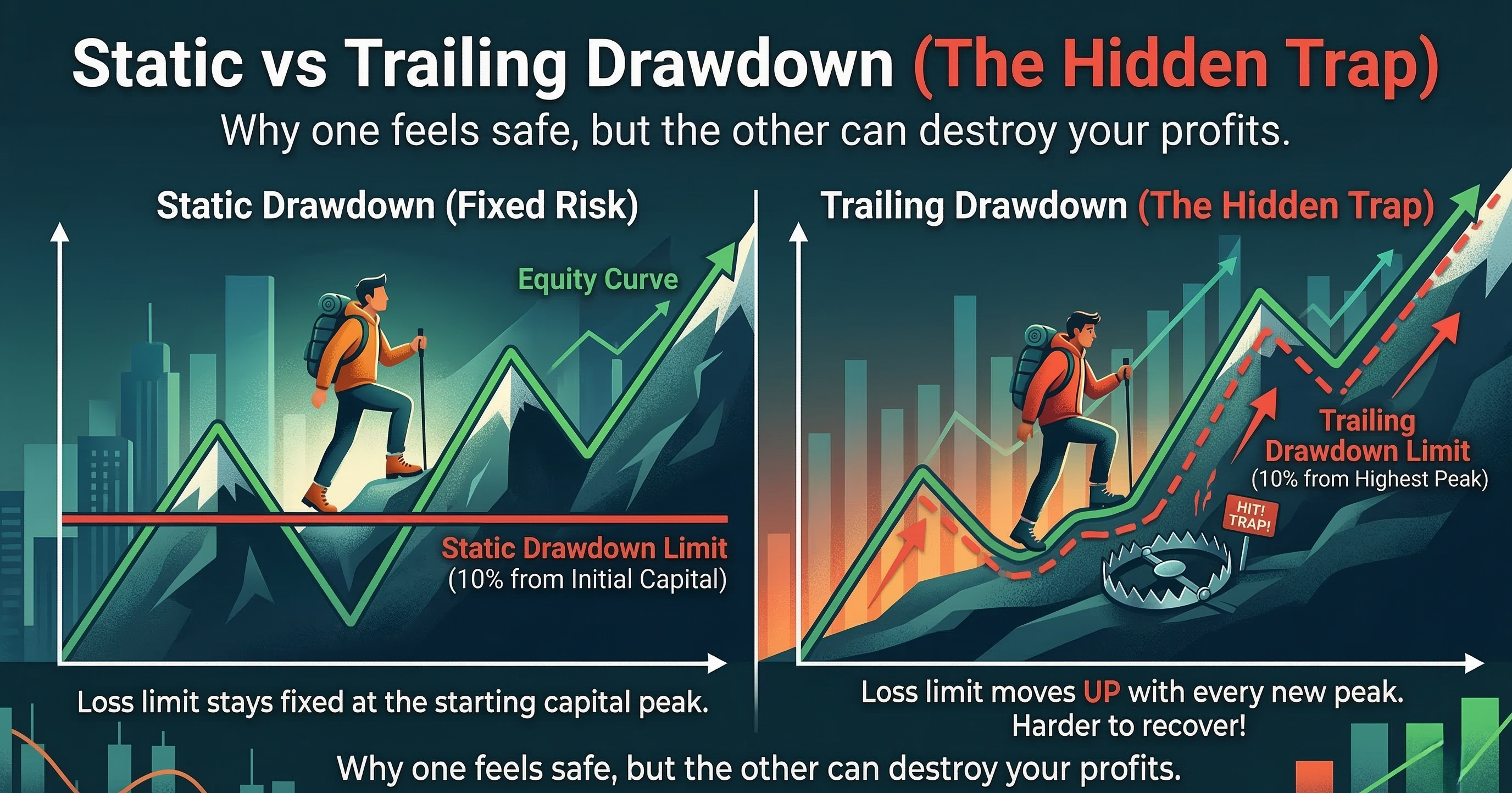
The key feature of static drawdown is this: the level never moves — no matter what happens in your trading.
Example
You start with $100,000. Your drawdown limit is $95,000. Now imagine you trade well and grow the account to $105,000. Your drawdown limit is still $95,000. That means you now have $10,000 of room before violating the rules.
Your risk buffer actually increases as you make money, which gives your strategy more flexibility to handle normal losing periods.
Trailing Drawdown
Trailing drawdown works very differently. With trailing drawdown, the loss limit moves upward as your account grows. Your maximum loss is always calculated relative to your highest equity level.
This means that when you make profits, the drawdown threshold moves closer to your current balance — and that creates a hidden problem.
Example
You start with $100,000 and a max drawdown of 5%. Your initial stop level is $95,000. Now you make money and your account grows to $103,000. With trailing drawdown, the system now recalculates your stop level based on the new high — so your new drawdown limit might move to $98,000.
At first this feels safe — after all, you're making money. But in reality something important just happened: your room to lose became smaller.
Why Trailing Drawdown Causes So Many Failures
This is where many traders run into trouble. A typical scenario looks like this:
- The trader starts a challenge.
- They make some early profits.
- The trailing drawdown tightens.
- A normal losing trade happens.
- The account is suddenly violated.
The trader feels confused because the loss itself may not have been large. The problem wasn't the trade. The problem was how the drawdown model changed the risk structure of the account.
Trailing drawdown effectively punishes volatility. If your strategy naturally experiences swings in performance — which most strategies do — the trailing model can quickly push your account into violation.
Static vs Trailing: A Simple Comparison
Static Drawdown
- Loss limit never moves
- Profit creates more risk buffer
- Better for strategies with normal drawdowns
- Easier psychological pressure
Trailing Drawdown
- Loss limit moves with profits
- Profit can tighten risk
- Sensitive to short-term volatility
- Harder to manage psychologically
Neither model is inherently good or bad. But each one changes how your strategy behaves inside the challenge.
The Real Problem: Traders Don't Know Their Numbers
Most traders focus entirely on entries. But prop firm challenges are really a risk management game.
If you want to survive them, you need to understand your own data:
- Your win rate
- Your average drawdown
- Your maximum losing streak
- Your average risk per trade
Because the rules of the challenge must match the behavior of your strategy. A strategy with frequent small losses and occasional big winners might work perfectly under a static model — but fail repeatedly under trailing drawdown.
Without knowing your statistics, you're essentially trading blind.
Why Trade Data Matters
This is exactly why we built Treydly. Treydly is a trading journal designed to help traders see the real data behind their performance. Instead of relying on memory, you can track:
- Your setups
- Your win rate
- Your drawdowns
- Your losing streaks
- Your strategy performance
Once you understand these numbers, you can choose prop firm challenges that actually fit your strategy.
Understanding drawdown rules won't guarantee success in prop firm challenges. But ignoring them almost guarantees failure. Because in trading, survival always comes before profit.
Analyse your trades with Treydly →
Watch: Static vs Trailing Drawdown Explained
Listen to This Article as a Podcast
Prefer to listen? This topic is covered in the Treydly podcast. Find us on Spotify or subscribe via RSS.
Track this in Treydly — free
Connect your MT5, MT4, or cTrader account, import your trade history, get all your statistics instantly.
Create Free Account